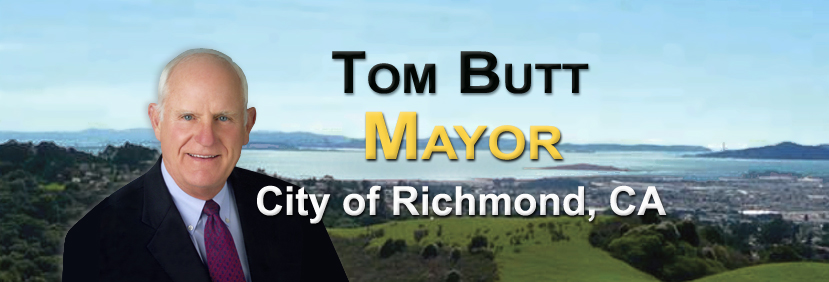
Running on My Record
As an incumbent, I have both the advantage and the disadvantage of running on my record.
The advantage is that the last six years have been very successful for the City of Richmond, during which I have been part of a very proactive progressive majority that has accomplished much. We have also been blessed with an extraordinary management team backed by talented and hard-working employees who continue to do more with less.
The disadvantage is that any challenger will always promise to do even better. Although such claims are pure speculation, neither can they be effectively refuted if someone wants to believe them.
Here is what we have accomplished:
- Crime continues to plummet, especially homicides, which are at the lowest level in decades.
- The condition of our infrastructure continues to improve, with the Pavement Management Index of streets up 32% since 2007. Parks and roadway medians are looking better than ever. Effective code enforcement has cleaned up the city, and graffiti is well under control.
- Aided by the end of the recession and fueled by the strong Bay Area economy, the Richmond population has gained 4,600 jobs since 2010, reducing the unemployment rate almost in half. Richmond businesses are adding hundreds of employees every month. The commercial real estate rental market is the strongest it has been in years.
- Based on the 2013 Community Survey, there have been remarkable improvements across the board over the past six years, indicating that Richmond is going the right direction in a hurry. Following are categories from the 2013 National Citizen Survey dramatic improvement in the past six years in the percentage of people rating the category as “excellent” or “good:”
| |
Overall Quality of Life |
|
+76% |
|
| |
Overall Appearance of Richmond |
|
+55% |
|
| |
Overall Direction Richmond is Taking |
|
+36% |
|
| |
Quality of Services Provided by City of Richmond |
|
+100% |
|
| |
Police Services |
|
+53% |
|
| |
Sewer Services |
|
+21% |
|
| |
Parks |
|
+16% |
|
| |
Recreation Programs |
|
+83% |
|
| |
Public Information Services |
|
+111% |
|
| |
Public Schools |
|
+10% |
|
| |
Public Library Services |
|
+51% |
|
- Capital projects, such as the rehabilitation of the Civic Center and the Marina Bay Parkway Grade Separation are changing the face of Richmond for the better.
- Richmond’s successful partnership with the National Park Service is raising Rosie the Riveter WWII Home Front National Historical Park to ever higher visibility and visitation, helping to make the Visitor Center, the Craneway Pavilion and Assemble Restaurant a regional recreational activity hub on Richmond’s Bay Trail.
- Although little tangible progress can actually be seen yet, Richmond’s successful landing of the projected Lawrence Berkeley National Laboratory expansion, now known as Berkeley Global Richmond Bay Campus, has focused a regional spotlight on Richmond and bumped its image and prestige.
All of these accomplishments contribute to an expanding quality of life in Richmond that attracts new residents and businesses, creates jobs and grows the tax base.
My Plan for Richmond
The first plank in my platform is to continue that progress and accomplish even more. For some, that is not enough. What is my plan for Richmond? What are my priorities?
My Plan for Richmond is simple – it is the Richmond General Plan 2030. It’s not just my plan; it is the community’s plan. It took five years and hundreds of meetings with thousands of people from the community to write. This is not just a land use plan; it has 14 elements, including Land Use and Urban Design, which cover every aspect of municipal public policy. The Health Element was the first of its kind for a general plan in California.
Many action items in the plan have already been implemented, for example:
- Action EC2.J – Port Emissions Reduction Plan
- Action EC3.A – Community Choice Aggregation
- Action HW1.A – Parks Master Plan
- Action HW4.E – Bicycle and Pedestrian Plans
- Action HW9.T – Quiet Zone Expansion
My Priorities
My Platform also incorporates the desires of Richmond residents as expressed in the City’s biannual survey. The full survey results can be found at 2013 Community Survey.
There are two sets of results, the first from the initial survey from National Citizen Survey involving randomly selected individuals, and the second from an on-line version that anyone could complete. The first was more scientific and the second more self-selective. The results were similar, but the self-selected survey reflected more satisfaction and optimism.
The demographics of the self-selected survey were individual who are typically wealthier, whiter and older.
In a policy question created by City staff, residents were asked how important specific issues are for the City to address within the next two years. Listed below are the top six areas that residents stated were either essential or very important for the City to address.
| |
Focus Areas |
|
Scientific Results |
Non-scientific Results |
| |
Reducing crime |
|
96% |
96% |
| |
Addressing blighted properties |
|
87% |
85% |
| |
Developing job training opportunities |
|
88% |
83% |
| |
Improving street paving conditions |
|
86% |
80% |
| |
Improving environmental quality |
|
84% |
83% |
| |
Increasing street and pedestrian lighting |
|
80% |
77% |
Taking a cue from the survey, my plans for the next four years include:
- Maintaining a high funding priority for both police and non-conventional crime prevention strategies that include technology (shot spotter, license plate readers and video surveillance), the Office of Neighborhood Safety and non-profits that are engaged in re-entry and violence reduction programs.
- Continuing to fully funding the City’s code-enforcement staff and supporting efforts to address properties that have been foreclosed or vacated or are in danger of foreclosure, including Richmond CARES and social impact bonds for recycling foreclosed properties.
- Providing funding and supporting programs at RichmondWorks, Contra Costa Community College and other job training venues that are preparing unemployed and underemployed Richmond residents for jobs. Since 2010, Richmond had gained 4,600 jobs, and unemployment has dropped nearly in half, but at 10.5%, it is still way too high.
- Supporting Measure U, which if passed, will provide $7 million in new revenue, the largest portion of which I would allocate to street maintenance.
- Supporting continued expansion of the City’s street and walkway lighting program. The City has recently purchased all PG&E-owned streetlights and is replacing them, as well as all City-owned streetlights, with new LED energy-efficient lights. The number of lights is also being increased. The total to date is about 9,000, and the energy savings is 50%. Lights on the Richmond Parkway that have been dark because of copper thefts are being repaired and re-lighted with vandal-proof wiring.
Regional Collaboration
Working with regional agencies is important for the City to tap into funding sources and programs, which is why I serve on far more regional agencies than any other Council member, including the Local Government Commission, WCCTAC, CCTA, BCDC, MCE and Contra Costa LAFCO. The information I derive from thee organizations and the personal contact and networking with other board members has resulted in millions of dollars in grants and appropriations coming to Richmond.
Some of the projects I am currently working on include the Richmond Ferry Terminal and ferry service, a Bay Trail extension to the Point San Pablo Peninsula (Point Molate) and across the Richmond — San Rafael Bridge. If I am elected mayor, these contacts and activities will be even more important.
Nuts and Bolts
As an architect, contractor, planner, developer, business owner and real estate economist, I bring a lot of education, experience and skills to bear on shaping public policy that makes things work, and I will, to the best of my ability, insure that the people of Richmond get the best possible return for their investment in City government and that every neighborhood is treated equally in the provision of programs and service.
Quality of Life
Quality of life issues are what make people and businesses want to move to Richmond and stay in Richmond. They create that essential sense of community and community pride and they contribute to people’s health and happiness.
Currently, many people simply need a job to enjoy any quality of like at all. The Bay Area job market is regional, and Richmond, alone, cannot provide full employment for Richmond residents. But to the extent that Richmond can attract and hold businesses, it will enhance the jobs-residents balance, reduce transportation times and costs and increase local economic activity that feeds on itself to create even more jobs.
Richmond’s new General Plan 2030 incorporates quality of life issues in a big way. There is evidence that businesses are both growing in Richmond and moving to Richmond because of the direction they see the city going.
The way cities are planned and the way they grow affects our health, our safety and our state of mind. Good urban design is not a luxury; it is, like healthcare, something we all deserve and must have.
As an architect, I know that the built environment profoundly affects people. For example, school children learn better in classrooms with natural light than they do in classrooms with artificial light. The design of cities for car dependence is a significant cause of the upward spiraling obesity and diabetes trend, especially in children. Access to fresh, outside air in buildings makes people healthier and reduces absenteeism at work and at school.
Since 1995, I have been a member of a statewide organization of local elected officials, the Local Government Commission, which is dedicated to building livable communities. I serve on the board of directors of the Local Government Commission, which I chaired for four years. I also serve on the League of California Cities Environmental Quality Policy Committee.
How you get to work, to school, to recreation and to shopping determines how much you spend on transportation, how much time you spend getting there and whether or not your journey is one that contributes to your health and that of your children. A successful and healthy City must provide a diversity of jobs, housing and economic opportunities for its residents. See http://www.smartgrowthamerica.org.
All of these also determine the carbon footprint of a city and whether we are part of the problem of climate change or part of the solution. As Richmond grows, it deserves nothing short of the best. I not only understand what constitutes quality development; I am committed to see that we get it.
The most bitter and emotional battles in Richmond are fought over land use. The City Council approved the General Plan 2030 and will later approve a new Zoning Ordinance to implement it. The City Council is often the last stop for development projects that are appealed from the Planning Commission or Design Review Board. Will we conserve our precious shoreline for future generations, or will we squander it up for cheap housing and industrial development?
For the 19 years I have served on the City Council, my detractors —the Chamber of Commerce, industry and developers —have characterized me as anti-business and anti-growth. They have done this because I will not allow sub-standard and poorly designed development in our city, and I know the difference between good and bad. For a person disparaged as anti-growth, it is ironic that I make my living based on growth — if there is nothing built, I am out of a job. I am also the only business person on the Richmond City Council; I have to make a payroll for 30 persons every two weeks. Why would I be anti-business?
Equity
Equity means that no one who is willing to join in the effort is left out or left behind as Richmond moves forward.
It means that the flatlands get the same level of services as the hills, and that all citizens have access to government, not just those with money and power.
It means that housing opportunities are available for every income level, that all residents can find decent jobs without spending significant portions of their lives commuting, and that, if they choose to commute, they have choices other than the automobile.
It means that industrial pollution is no more acceptable in poor neighborhoods than in wealthy ones, and that those neighborhoods where pollution has been concentrated deserve our help to continue making the air cleaner, prevent future industrial accidents, and assist those whose health and economic prospects have suffered by their previous exposure.
Finally, equity is also about responsibility and accountability; we all have an obligation to participate in public life in some way to ratify our citizenship, even if it only means getting out to vote once a year.
As a City Council member, I will measure every municipal service and initiative by its equity, and I will work to ensure that our city government hears and responds to the concerns and needs of all Richmond residents.
Our City – Our Choice – Our Future
Together we can make it happen.